life stories

Welcome to Coconut Connections

Real life stories

Sunday, December 25, 2011

The attack on women and children.

The following story took place in 1946(which I think should be 1945) in then so called Dutch Indies, in a Japanese concentration camp.     ( written by Dinky ) see her blog www.storiesofdinky.blogspot.com

Vibrant and jubilant, liberation had taken her entrance.It came suddenly, almost as a surprise, in one single day. It was great, seductive, intoxicating, unbelievable. Sitting up there in the tree,
looking over the camp wall to freedom with a bright happy feeling. "We made it". Other children in the tree laughed and shouted to each other and pointed at the mountains. But then, a terrible noise coming from everywhere, a whistling sound, something that flew past your ear, danger! Like apples we fell out of the tree. Mothers came running to us, yelling "Come along,they attacking us". Bullets, running, fleeing into our small rooms, quickly on the ground, what is happening, than loud yelling on the other site of the wall:"merdeka". My mother shouted to us, run, the Indonesians are coming. Then we saw them coming over the wall like pirates with war colors on their faces and guns, other weapons, frighting looking fellows. We ran as fast we could. More Indonesians came over the wall, everyone ran in panic into the narrow pathway to the other side of the camp, to the very large open field. There also were Indonesians yelling: "merdeka, merdeka". We all ran on the field as far to the end as possible, there were already a lot of people. The Indonesians stood in a broad circle around this big field, they stood everywhere with riffles at gunpoint, waiting for the order to shoot.
In some of the barracks, all women had barricaded the doors and windows with their beds, and some luggage, they did not want to come out, which ultimately was our salvation. it lasted and lasted, everything was silent, fear full we stood there on the field listing if they would get them out of the barracks. Suddenly they began shooting at random and throwing grenades,"get down"! people screamed, "get down"! we also screamed.The men that already had come back to their wives and children in our camps, threw the grenades back as fast as possible. Everyone was dead silent and we all began to pray. Laying flat on the grass, I suddenly felt a terrible blow close by, it was so bad that I thought my chest would burst apart and I had blood all over me and pieces of all sort of things.Oh,God, I am dead, everything is broken this is it. How strange, I can still hear, I can still see, if this is death, that cannot be so bad. How strange I can still move my fingers. Oh,God, I am only wounded, but I don't feel any pain.
Carefully, I looked at the things that were lying upon me."Where, where am I wounded?" Then I heard my mother's voice: get up quickly, we have to get out of here, we have to go further to the back, quick, quick", can't do that, oh God, it is not mine, it's someone else's. I could not fully believe it. But standing up and running I found out there was nothing wrong with me. Away, far away, we ran as fast as we could to the back, where no Indonesians were. In the running crowd we lost my brother and went for the toilets were we crept on top of each other. My mother then heard my brother crying. She called:"Anton, we are here". He came to our toilet. Weeping he said:"Mummy, how should I pray?" You never forget something like that. Cramped together we all were praying aloud, waiting to be killed. After some time we heard even worse shouts from the rooftops. Everybody in our toilet looked up with terrible fear in their eyes, which I never will forget, this is the end, they said. Kiss your children goodby, we will die. More terrible shouts and  noise, then shooting, bullets were flying around, pops, running, screaming was all we heard. Absolutely terrified we waited.
Someone yelled:" They are ours, it's the Gurkha's, it really is". It became dead quiet. Was it possible, would we be rescued? Very carefully some went looking and saw dark men passing by, grinning and laughing at us:"The Gurkha's, the best warriors there are", someone said. "They come to liberate us". Everyone started to cry and thank God. And yes, one hour later they had captured some Indonesians and others fled. We came creeping out of our toilets looking around for relatives, we found my grandmother, who was overcome by panic, had ran so fast that she fell down, and kept silent as if she was dead. How you feel then is indescribable. You get your life back, you live, it's the most wonderful feeling in the world. I have never forgotten this feeling.
I didn't want to tell this story at first, but my eldest daughter made me do it and I am glad I did.

Dinkie

see other stories from Dinkie( www.storiesofdinky.blogspot.com)

This story is similar to what I heard from my aunt, my mother and two camp friends from my mother and aunt.
It was 1961, and I was getting married. The problem was I did not have any papers or a birth certificate.All our papers were lost in Indonesia in the war. The Town's Municipality in Bandoeng on the island of Java, Indonesia, where I was born, was burned down to the ground. In future I had no proof who I was.  My mother had to find three people, who had known me when we lived in Bandoeng. This was no easy task. Everybody she knew from then, was no were to be found. My mother did not even know if they had survived. She received some letters from them,(which I found, after my mother passed away) when she arrived in the Netherlands at the end of April 1946.
They had hoped to leave Indonesia in the following year. My mother never heard from them again. Lots of Dutch were still losing their lives, it was still a horrible dangerous time in Indonesia. The extremists were fighting for Independence. Holland send lots of troops and the fighting continued for 5 year long years.

Finally the Court in the Netherlands allowed us to have people to testify, who she had known in Japanese prison Camp. She was able to locate two people. The court however told her she needed three. Well she could not find three, so they allowed her, after months of trying to find a third one, to have her sister to testify. It was costing us a lot of money and heart ache for my mother. She cried a lot that time. I never forget. It was very sad.

She often told me this story:" now you see that my story was true, you fell out of a coconut tree right in front of your father and me, when we were walking on this beautiful street in Bandoeng. The coconut fell  and burst open and there you were.We picked you up and took you home, no wonder you have no birth certificate".

On September 29, 1961 we were finally standing in front of the Justice of the Peace Mr. J.E.Goudsmit in Haarlem, in the presence of Mr. H. van de Poll, deputy registrar: and two people my mother and my aunt knew from the time they had been in Japanese prison camps.
Elisabeth Thiel, spouse Hendrik Cornelis van Vaas
Marijtje Postma, spouse Abraham Seijderveld
My aunt Eke Sijtsma, widow of  Tobias van Driel
My mother Sietske Sijtsma, widow of Klaas van der Wal, my father.
They had to swear with their hands on the bible, that I was the daughter from her beloved Klaas who had died a terrible death on the "Death Railway", on the River Kwai in Kuye.
It was an emotional day for all of us.

After they had testified that I was Tetske Trijntje van der Wal we all went to my mothers house for lunch. That's when I heard the above story . I remember how gruesome it was, they had seen Indonesian kids, who could barely hold a gun, shooting their friends in cold blood. Some of these young boys had machete's and killed little children, whoever was in their path.It is horrible to write down what they told next, because we have to face the past history with the utmost sincerity, and hope this will never happen again.
They were talking that there was so much blood everywhere, and they had never seen so much hatred from these young boys and Indonesian men.The Japanese had done a terrific job,they had brainwashed and taught them well, how to hate "Blanda's".(white people). It was very sad, because some of these young boys, not older then 14 years old were killed by these Gurkha soldiers. So awful sad! So much waste of life.
The Gurkha soldiers stayed with us in the camp and protected us from the extremists. Not until the end of November 1945 my mother and I were able to leave this camp, under the protection of the Gurkha's, who fought for the British. They were very friendly men.
I am forever thankful to these men.If it had not been for the Gurkha soldiers the whole camp would have been slaughtered.
Two years ago when I visited my aunt the youngest sister of my mother Anneke Sijtsma married to my favorite uncle Kees Pool she told me this same story, which my mother had once told her, so long ago.My aunt is 84 years old now, at the time that my mother and I arrived in the Netherlands in 1946 she was only 19 years old.She told me that some of the things your mother had told me are not to describe.My aunt said that at the time she was busy with her own life and did not take much notice about the things my mother was trying to tell her. She now cries and can't barely forgive herself. It is hard for her to talk about.She becomes very emotional.But I am glad she was able to tell me some of what my mother had told her.I would have never known some of the things my mother had gone through, if it had not been for my aunt.
I understand now how difficult it has been for my mother after the war and being back in Holland.I loved my mother dearly, she was on this earth only for her children and grandchildren, nothing else was important to her.Food to her was her no 1 priority, she was always afraid we were not eating enough. She drove us sometimes insane. Now I understand. Having not enough to eat, all those years in Japanese captivity , and seeing little children die from starvation and malnutrition has haunted her all her life.

The Gurkha soldiers are a culture of people whose warriors are almost unmatched in fearlessness and skill and have been so for hundreds of years.
Brave Gurkha soldiers are still sent to spill their own and other people's blood in the four corners of our deeply troubled world today.
This monument stands outside the Ministry of  Defense, city of Westminster,London.

Tuesday, December 20, 2011

Justice for victims from former Dutch-Indies.

Elizabeth van Kampen forwarded this article to me, which was in the newspaper in The Netherlands
the"Trouw".


JUSTICE FOR VICTIMS FROM  FORMER DUTCH-INDIES
--------------------------------------------------------------------------------------


The foundation of Japanese Honorable Debts, is asking for justice how the Japanese military forces had violated the Convention on Human Rights in former Dutch-Indies during World War II.


Japan still has not recognized that the Japanese military violated ' the Convention on Human Rights' purposeful and deliberately to liquidate all Dutch nationality in and outside the concentration camps.Under the slogan 'Asia for the Asians', Japan tried to colonize the Dutch-Indies for use of  its own purpose and would not shy away to use any certain coercive measure.

Come to terms with the past
The Foundation of Japanese Honorable Debts,accused Japan by a written verbal at a meeting of the United Nations in Geneva for violating the Convention of Human Right.The Foundation request that the council of the Convention on Human Right should point out to Japan that it has not recognized the obligations they owe to the Dutch victims or their next of kin. The purpose of the Foundation is to fight for the primarily aim of the interests from the former Dutch of the Dutch-Indies.

Victims
Before the war plus minus 300,000 Dutch lived in the Dutch-Indies. Plus minus 100,000 ended up in Japanese concentration camps, plus minus 40,000 were taken POW and plus minus 160,000 lived still outside the camps, 20% of these Dutch died. Every second Tuesday of the month a demonstration takes place in front of the Japanese embassy in The Hague and a petition is handed over to the Japanese ambassador the first Minister of Japan.

Peace treaty
The Netherlands signed a  peace treaty in 1951 with Japan, and forfeit all individual fundamentals of compensation to the victims from the Japanese Regime..The Foundation of  Honorable Debt is trying to organize together with other organizations to get the Dutch Government to realize that the Dutch from the Dutch-Indies did not receive any justification from the Dutch government and that they have not been treated like the Dutch in Europe in World War II.

You like to know more?
www.jesinfo.org
www.65jaarkinderenvanderekening.nl
You can read the book'Ooggetuigen van Oorlog' which has 60 stories from the Dutch victims.
You can order this book in Dutch or English. For 10 euro in Dutch and 12.50 euro in English.
You can send it to Stichting Japanse Ereschulden , The Hague.ABN-AMRO, bank number 42 73 42 787


Monday, December 19, 2011

A letter from Richard Kandler. author of " The Prisoner list".

Dear Thea

Many thanks for contacting me through the website- and thanks, too, for buying my book.

Interesting about the date of 8 November. Strictly speaking the publication date was last March, but because of the way that the book is produced a date always appears on the very last page which is the date when that particular copy was printed. The fact that your particular copy was printed on the very day of publication of your own book is certainly a remarkable coincidence.


THE PRISONER LIST is a compelling account of the experiences of a former prisoner of the Japanese: the humiliating defeat at Singapore, forced labour on the Saigon docks, and the horrors of life on the infamous Burma Railway.

I THOUGHT YOU SHOULD KNOW  is a true story about the life of women as prisoners of the Japanese.The brutal atrocities they had to endure, whilst in these camps, and how they survived.

The Universe works in mysterious ways; 5507 kilometers or 3422 miles apart, a son( Richard Kandler) is writing about his fathers experiences as a former prisoner of the Japanese and miles apart
 I am writing at the same time about my father who died on the infamous Burma railway and about my mothers experience as a former prisoner of the Japanese in these infamous women prison camps.

Many stories have been written about the holocaust  in Europe.But what happened on the other side of the globe was often overshadowed by the Holocaust in Europe.That world war 2 was also fought on the other side of the world was forgotten. When world war 2 was over in Europe and people were celebrating, the POWs in Japanese prison camps, and the women and children in Japanese prison camps were still trying to survive.
The Japanese surrendered on August 15, 1945, not a moment too soon.
All the POWs- tens of thousands of them- had been scheduled for total annihilation later that month, at the order of the Emperor Hirohito.

Another letter I received from Richard Kandler. Wednesday March 16, 2011
subject: "I Thought You Should Know"

Dear Thea

I've just finished reading your excellent book "I Thought You Should Know".

Your children were absolutely right to encourage you to write it, and I am glad that you did- even though I imagine that the exercise must have been very painful for you at times. I have read many books about the railway, but not about the treatment of women and children, and so I believe that I learned a lot from reading it.

I do not understand how innocent civilians could be treated with such cruelty, with mothers being beaten and humiliated in front of their own children. Your mother must have had a very strong personality to survive all that and protect you from the true horrors of what had happened in the years after the war, but of course you heard what you heard on the stairs and eventually you pieced it all together. The title of your book-"I thought You Should Know"- really hits the nail on the head.

The book is very movingly written- straight from the heart- and is excellent set out and presented. The use of photographs worked particular well, I thought- particular the one of you on page 57, looking so sad and so haunted, and your father's photograph on page 42 which is almost completely worn away from his holding it. I found that heart-breaking.

It is terrible sad that your father never came home. Incidentally, my own father (who fortunately survived) was at Kinsaiyok at this time, which was just one stop along the line from Rin Tin. They may perhaps even have seen each other on the railway.

Thanks again for writing this marvellous book and for drawing my attention to it.

Best regards
Richard

THE PRISONER LIST

A left-hand page from the original 'prisoner list'- but the true horrors were on the right-hand pages.


Written by his son, The Prisoner List also tells of the astonishing twist of fate that saved all the surviving prisoners from mass extermination at the end of the war.

The book's title refers to a handwritten list of names (which still exists today) maintained under the most dangerous of conditions during WWII. The list was compiled by the author's father in a succession of Japanese POW camps and became one of a number of forbidden items that he kept hidden from his captors at risk of torture and execution.

It was a list of the first thousand Allied prisoners to have been shipped into slavery following the fall of Singapore- not just their names, but what had happened to them since; deaths from starvation, tropical diseases, the refusal of medicines and the daily beatings of sick men onto the railway; and deaths at sea on "hell ships" bound for Japan.

The central red entry records an execution at Saigon, following a failed escape attempt.

He was concealing other items too- including a stolen newsreel and a secret cash box containing illicitly obtained local currency used for the benefit of the sick prisoners. As security tightened and the camp searches intensified, he went to increasingly extreme lengths to hide these from the prison guards and from the dreaded Japanese military police- with the net closing in all the time.

The Japanese surrender on 15 August 1945 arrived not a moment too soon-and not just for him. All POWs tens of thousands of them-had been scheduled for total annihilation later that month.
The first few lines of Reuben Kandler'[s 6-page essay("my Expieriences as a POW in Thailand"), written shortly after completion of the Burma Railway and reproduced in full at the end of the book.
(note the splinter of bamboo used as a staple)

If you like more information about his book go to:  www.theprisonerlist.com/about-the-prisoner-list.html 

My book "I Thought You Should Know" is available at amazon.ca.at xlibris.com.and at barnesandnobles .com and in your local bookstores. My book is written under my maiden name;Tetske T. van der Wal

My father was a very good artist. He had made a drawing of me on two Japanese postcards, which a fellow prisoner Mr. E. Veenstra had been able to save for my mother. He had a few more items from my father, which he had hidden., after my father passed away  in September 1943. Finally in March, 1946 Mr. E. Veenstra located my mother and me in the Java Center in Bandoeng, where we were taken after the war.At the Java Center my mother was recovering from malnutrition, malaria etc.She had been very sick,and was barely alive when we were freed from the Japanese occupancy.In the letter from mr. Veenstra, which I found in  my mother's possession after she passed away, he wrote that he had been very concerned about her health.It took my mother three months to get her health back.
It's a drawing of me on a postcards.The card on the right was suppose to protect the drawing the stamp is cut away.
This drawing is done by my father, he never was able to finish it.

The above picture is drawn in camp Moentilan and it is signed Nv/d Molen, it's February 1945.This drawing of me was done on a piece of paper with some Japanese propaganda on the back. I was 4 years old.This drawing I used for the front page of my book.


Sunday, December 18, 2011

One day I hope to visit my fathers grave.

One day I hope to go to Thailand, to visit my fathers grave. Maybe next year sometime. I like to see the River Kwai, it looks so peaceful now. I never got to know my father, he died building the Burma railroad tracks, working as a slave for the Japanese in world war 2. I was only 2 years old when he passed away. But lately it feels like I got to know him better, and I would like him to know, that we never forgot him, and never will. I like you to know Dad that our daughter Monique, your granddaughter is the spitting image of you. When I look at your picture I see your granddaughter. It is very sad that young men like my father never had a chance at life, but through my blog I hope your spirit stays alive and my children and grandchildren get to know you a little, you deserve it.
My father passed away on September 18,1943 building the infamous railway line as a Japanese POW.

Everywhere in the jungle the grave-yards made their appearance. When the railway was completed at the end of October 1943, thousands of bodies lay in the jungle from one end of the railway to the other. My father was one of them. His friends had laid him to rest in Kuie, a small graveyard site, beside the railroad tracks.He died of total exhaustion,dehydration and starvation. A fellow prisoner Mr. Veenstra, told my mother about his last days.Mr. Veenstra was one of the lucky ones to survive this ordeal.
The prisoners lived their captivity as an endless nightmare and with no hope. Many died of despair. The fortunate to awaken from their ordeal were never the same again. The nightmares returned to haunt their sleep and the faces of those left behind have never left them.
We will never feel the pain they endured and fortunately we can awaken from the despair,that despair that became their living hell as Japanese POW's.
They made it, the war was over, but their nightmares began.
The most demanding part of the Death Railway with the largest loss of life was between Konyu and Hintok, where my father and his friend were. Rin Tin was the worst place to be.My father was there for three months, until the Japanese finally closed this camp,  because cholera had broken out, and they were afraid they would catch these diseases.This part of the railway track had taken a toll on my father. He had become a skeleton and suffered from dysentery.The hammer and tap method was used to cut through rock. The guards were very brutal as "SPEEDO" was being administered, one such cutting became known as Hellfire Pass. Most of this terrain is steep, strenuous up-hill.They were working from early morning to late evening. There they were trotting down the muddy track to their work on the railway in the middle of the jungle, with no way out. Their skeleton like forms fading into the jungle like living zombies, their thin arms and their dirty uniforms hanging in tatters. Some barefooted, without hats, literally dying on their feet and walking, shouting and bellowing followed the Japanese guards, their riffles slung over one shoulder and a bamboo stick in the other.

The Japanese seemed to have one thought here; if you are not working you are dying. Their one thought was the railway. It had to be built; nothing was to stand in the way. There were plenty prisoners.
It was shocking what happened there in the jungle on that railway. The monsoons had started and everywhere was mud; the huts were falling to pieces full of bugs, and all prisoners Dutch, English, Australians, looked dreadful. There they were slipping and sliding down the muddy track.
There was a smell of decay in the whole camp of stagnation. The camp hospital was another miserable hut, falling to pieces and inside lay the remnants of what once were fine young men, dying in loathsome squalor. The stench of bed-pans, the groans of the men with malaria, the dirty smell of sweaty clothing, the lice and the smell of bug infested bamboo-beds filled the air. The Japs had only one thought and that was the railway. Nothing would stand in their way.


I came upon this poem written by Margaret Puffett, she visited the Tamarkan Bridge, on the River Kwai. Her father died as a POW working on the rail road line, and I hope she does not mind I post her poem here on my blog. This is for all the dads who did not make it back home.Never to be forgotten.

Visit to Tarmakan Bridge;
by Margaret Puffett.

 I stood upon the famous bridge that spans the River Kwai,
I stood beside the rail-way tracks where so many had to die.
Beaten, starved, their spirits unbroken they worked from morn to night,
To build the Burma rail-way stretching on and out of sight.

The River Kwai flows silent now, its waters still and deep,
It saw it all but never tells the secrets that it keeps.
Across the Bridge beneath a tree I laid a tiny cross,
A small but loving token to commemorate my loss.

And in silence and serenity,I said my Prayer to God,
Was I standing on the spot where my father once had trod?
The men long gone, the rail-way tracks and bridge in memory stand,
A memorial to those who died in protection of our land.

They died to give us freedom, through the trouble, war and strife
And paid the greatest price of all, the sacrifice of LIFE!
A daughter visits the bridge on the River Kwai
"The memory# of that trip will stay with me forever!

The Bridge, the River and the Rail-way- so peaceful now,
It's hard to believe what went on here.
But to be able to lay flowers at the Railway and at the cemetery,
I felt Dad knew we still loved him, and never forgotten him.


The rail way at the River Kwai.
Kanchanaburi, Thailand

Kanchanaburi, the Cemetery.

Rest in Peace.


Saturday, December 17, 2011

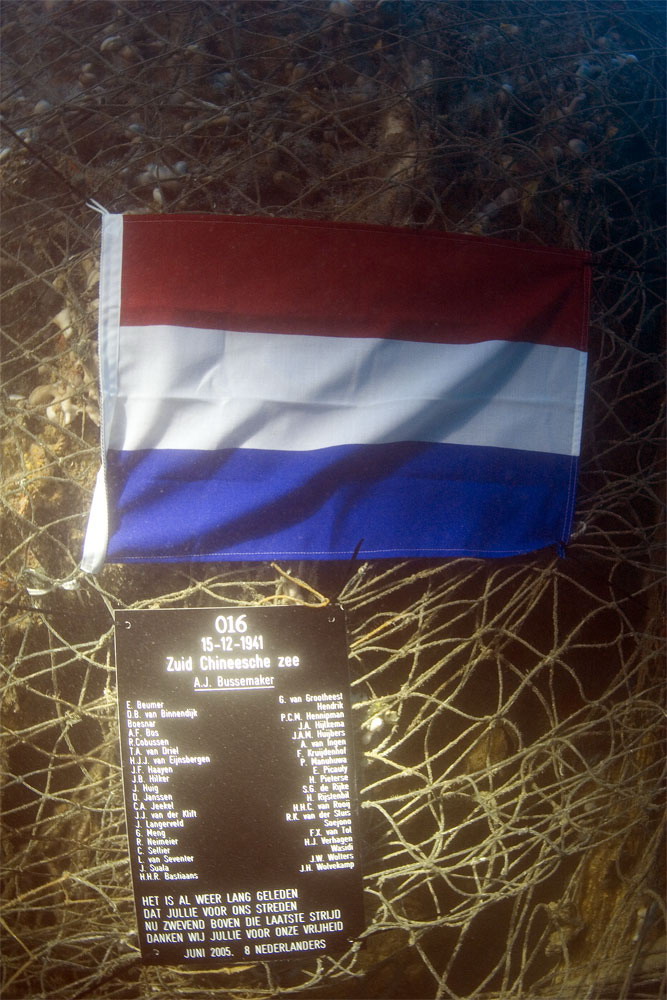
December 15,1941, The 016 run a mine.


Today December 15, it is exactly 70 years ago, that the 016 was struck by a mine while she was exiting the Gulf of Siam during her home-bound voyage to Singapore.The submarine was nearly broken in half and 41 men are lost. My uncle Tobias van Driel was one of them. He was a petty-Officer Electrical Mechanic. My aunt and uncle lived in Soerabaja on the island of Java, Indonesia.
Boatswain Cornelis de Wolf, survives. The 016 had sailed right into a Japanese line of mines.
In October 1995 a wreck, located off Tioman is identified as the Dutch submarine 016.
A Singapore dive expedition filmed and documented two Dutch submarines lying on the seabed off Pulau Tioman in Malaysia. The 016 and K 17, relics of World War 2, are the watery tombs of about 70 officers who drowned when the submarines were sunk in the South China Sea by Japanese mines. Both submarines were based in Singapore under the British eastern fleet command, when they run on a Japanese mine,exploded and sunk on December 15, 1941.
A Singapore team have filmed the two sunken Dutch submarines and the film footage is offered to the Singapore History Museum.
Their watery tomb.


Today was a historical day. Today 130 students and nearly 200 Toronto teachers, school trustees and social justice advocates-plus 100 more from Ottawa- did present a written request to the embassy of Japan. On this same day, some of the frail, remaining "comfort women" will make their 1,000th consecutive weekly appearance outside the Japanese embassy in Seoul Korea to demand the same apology from the Japanese government.
In the Netherlands the 205th petition was presented to the Japanese embassy in The Hague.

Heartfelt apology?????

These are a few comments on the Japan issues 'heartfelt apology' to former Canadian prisoners of war;

HYPOCRISY
This so-called  "apology" is just some kind of PR show by the Japanese government to further confuse ordinary people who know too little about this chapter of history. The Japanese government and the right-wingers will again say that we have this and that officials apologized, how many more apologies do you want. If this is genuine repentance of Japan's war crimes, why such apology cannot be passed in the Japanese Parliament? Why such apology does not come with any reparations? As one Japanese MP said many years ago regarding Japan's war crime responsibility,"Apology without compensation is a hypocrisy; compensation without apology is an insult to the victims." In these 2 years, the Japanese government has been using this kind of PR show for Allied POW, including inviting some POWs from the US, Australia etc to visit Japan and offered this kind of insincere apology with no support from the Japanese Parliament. All of these "apologies" were without any reparation. Where is the sincerity? Even worse, these kind of "apologies" were only offered to "White" POWs. What about the people in most suffered countries, such as China and Korea? How can we accept this kind of double-standard? If Japan is sincere in their apology, why the museum at Yasukuni Shrine still portraits the war of aggression as a holy war that it's for the greater prosperity of East Asia? If Canadian government is really accepting this apology, then our government should follow-up to ask for reparations for these Canadian HK Vet, at least to recover the payment offered to these victims in 1998 by our Canadian government using our tax-payer's money. Why should we Canadians pay for Japan's war crimes? Our government should also urge Japan to pass an apology and compensation resolution in the Japanese Parliament to redress all victims of Japanese war crimes so as to resolve this issue once and for all. We Canadians are not just concerned about our own Canadian justice, we also are concerned about the justice for victims of other countries.

JAPAN'S SHAMEFUL INABILITY
.....to apologize. Yet receives apologies from governments like Canada, including financial compensation, Japan has not apologized to the Koreans for what they did from 1910-1945. The Japanese soldiers made the Korean women into sex slaves and tortured them mercilessly. These barbaric acts are recent and many of these "comfort women" exist still today. What is wrong with the Japanese that they think honour is inherent, yet their behavior is selfish and apathetic? I can spit on you but don't dare spit on me? The Japanese elders teach their youth this racism and xenophobia, so don't be fooled by their kind appearance.

CROCODILE TEARS
Twenty years ago I'd have felt that this apology actually meant something. Now it's just a politically correct gesture so the history can be swept under the rug and forgotten. Most of our men who were enslaved and tortured are dead and will never hear this too late apology. Unlike the Germans, the Japanese have never faced up to their crimes against humanity. What they did in China and what they did to innocent women and children in The Dutch Indies, was as evil and horrible as it could possibly be. They've yet to apologize for it. As for what the Allies or the US did to Japan; the Japanese wanted war and they got it.

There were 33 comments, too many to write them all on my blog. I must say most of the comments were the same as above. The Canadians are not buying apologies from the Japanese. Most of them agree on the above, and wished the apologies come with reparations. To apologize only is hypocrisy and an easy way out.

THE FUTILITY OF WAR;


POEM 'STAIRWAY TO HEAVEN'
by; Ray Watson;

I heard ten thousand mothers weeping
For their sons so far away.
I dreamed ten thousand sweat hearts sighing,
As they hope, and wait, and pray.
Like an epitaph- the 'Infamous Railway,'
Haunted by the ghosts of men.
For every sleeper a life was taken,
A stairway from the depths of hell.
Perhaps there is some good in all men,
And may the passing years prove so.
Lord; let the tears shed by their mourning
Serve to let the whole world know.

Friday, December 16, 2011

"Peace Monument" for former'comfort women' (sex slaves for the Japanese)

A huge victory was established for comfort women, as the Japanese government continues to lobby for its removal.
The doors and windows of the Japanese Embassy in Seoul are firmly shut, with only the surveillance TV cameras greeting the elderly women who demand that Japan apologize and pledge to come back next week.

Japan you cannot continue to turn your back, as a 130-cm bronze sculpture of a young girl was erected Wednesday on the road in front of the Japanese embassy in Seoul's Jongno District.

The"Peace Monument" was designed to give shape to the spirit of the "comfort women" who have come to the area every Wednesday for the past twenty years to call for an apology from the Japanese government.


Dressed in a hanbok,traditional Korean outfit, the girl sits on a chair with her fists on her knees, looking quietly toward the Japanese embassy.

I read in the Toronto Star an article about GTA (Toronto) students  who join "comfort women's" quest for justice.They went to Ottawa and participated in the demonstration in front of the Japanese Embassy.

The students had never heard of 'comfort women,' the cruel label Japanese soldiers used for the 200,000 young Asian girls they turned into sex slaves during World War II.
But a history lesson last week has sparked an outrage that the 16-year-old will take to Ottawa.On Wednesday the students had an unusual school trip to witness the largest peacetime protest held outside the Japanese embassy.

They were kidnapped right off the street and raped up to 30 times a day and in most cases it ruined their lives
.
130 students, 200 Toronto teachers, school trustees and social justice advocates-plus 100 more from Ottawas- presented a written request to the embassy.
Numerous countries have also made the same request, but to-date the Japanese government has not admitted to having ever set up the grisly 'comfort station' shacks for Japanese soldiers to use near the front lines.
I wonder is Japan ever going to admit to their war crimes?
"If a girl or a woman refused to do what they wanted, she would be tortured or put to death." said the organizer Dr. Joseph Wong of Toronto, an expert on what is believed the most sweeping case institutionalized sexual slavery in history. His organization AL-PHA (Toronto Association for learning and Preserving the History of World War 2 in Asia) seeks to spread awareness of atrocities often overshadowed by the Holocaust in Europe.
ALPHA helped design lesson plans for Ontario students about this horrific practice-something that is not taught in Japan, Dr. Wong noted.
This is unlike Germany, which requires all students to learn about the Holocaust.
It is important for young people of today to know about World War !! in Asia." Are these lessons too gritty for young teenagers?" the history teacher, from Falan's school said."It is gruesome; what happened to those young girls, was just sick, and many died lonely and shunned by their villages," said a grade 10 student ." But it is totally appropriate for us to learn about this because it did happen."
My mom, a very happy smiling young woman.


Mom this statue is also for you and your sister and all the women who were abused by the Japanese soldiers in World War 2. My mother and her sister were raped by these soldiers of Japan, in Moentilan on Java,in the Dutch Indies, while in this concentration camp, they passed away a couple of years ago.They never talked about it. They felt shame and humiliated. I wished they could have seen that statue.. A war is horrible, a war turns mankind  into beasts..and worse.Two years ago when I visited my aunt,the youngest sister of my mother I told her that I was working on a book, about our years in Japanese concentration camp on the island of Java, in the Dutch East Indies (now called Indonesia)She asked if the book was finished and I told her, almost. Then she said to me that she had to tell me something which I should know.She became very emotional and was barely able to tell me what my mother had told her.
She had to promise my mother never to tell any one, she had been so worried that their mother would hear about it.Their mother at the time was very sick and died soon after.She never knew what had happened to their two daughters in that far away land in the Dutch East Indies in those Japanese concentration camps.I was shocked, never in a million years I had thought my mother and her sister were victims of rape, that this had happened to them.My mother had told me once that there was a church on the grounds of the concentration camp in Moentilan and that very bad things happened in this church.The Japanese had set up office in this church.She often was talking about her believes and that she had lost her believe in God, because of what happened in that church.How could He allow this, she often said. I did not know that she was talking about.....rape....Sometimes she told me a little about these concentration camps, when I asked her about it.At the time we were Japanese prisoners I was only 4 years old.One day I was searching the internet about this Moentilan women prison camp and I saw a picture of a building; to my surprise this was the building I always tried to describe to my mom. I could remember that my mom one day was in front of that church and I saw her throwing up. And I asked her if she fell, because she was bleeding..She always denied it, when I spoke about it.My mother and I , my mothers sister and her two children were in Japanese Prison camp for 31/2 years.
My Aunt is the youngest of  nine children and is the only one still alive. She lives with her husband in Kolhorn, a small village in The Netherlands.My book was published in November 2010. "I Thought You Should Know", it is about our time in Japanese prison Camp on the island of Java.
This picture was taken just after the war. A very haunted looking young women.
A look in her eyes that shows so much  heart ache.


The Japanese government remains silent. Japan remains silent.


"Listen Japanese ambassador, listen to Korea. Tell the Japanese government that the world is on the road to real peace. Make an apology before we die!" said Kim Bok-dong, one of the surviving victims attending the historic rally.After a deep sigh, and trying to hide her emotions, she added,"We Koreans can do anything if we stick together. I"d be grateful if our government could sternly tell the Japanese government to apologize and provide compensation."
Another survivor, Gil Won-ok, said,"The Japanese people are not apologizing. I have a feeling that our 1,000th  weekly rally will end only in vain. How discouraging! I hope we Koreans do our best in our respective positions to prevent future suffering of this kind."

Gil-Ok dismisses any talks about treaties with Japan as "nonsense". The Japanese are not the kind to be helping us", she says referring to the proposed military pact."They can't even repent for the past wrong doings. And now they talk about signing treaties? What nonsense."